What Are Noise Regulations at Work for Collators in the UK?
January 8, 2026
Noise regulations at work for collators in the UK are defined by the Control of Noise at Work Regulations 2005. These regulations set l...


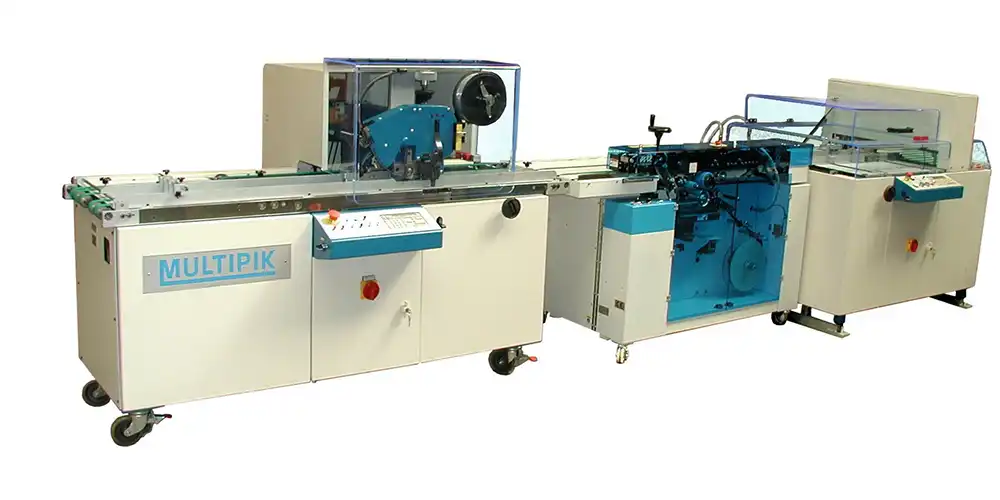
Selecting notepad glue for industrial pad book lines directly affects tear-off performance, achievable line speed, equipment reliability, and finished pad consistency. In automated production environments, adhesive behaviour determines how reliably paper stacks move through collating, binding, drying, and packaging stages.
There is no single notepad glue that performs optimally across all industrial applications. Hotmelt, EVA, and PVA adhesives are all used in commercial pad production, with suitability determined by throughput targets, paper structure, pad thickness, and line configuration.
This article explains how these adhesive types behave at scale and how correct selection supports stable output while reducing waste, downtime, and production variability.
In automated pad book lines, notepad glue serves as a process variable rather than a finishing material. Adhesive performance determines whether paper stacks remain secure at production speed, cure within available dwell times, and separate cleanly during end use without disrupting line flow.
Industrial pad production requires adhesive systems to operate within defined limits for viscosity, application consistency, and curing behaviour. When adhesives fall outside these parameters, line stability deteriorates, increasing intervention, extending drying requirements, and introducing variability into tear performance.
UK Government manufacturing guidance identifies material compatibility as a critical factor in automated productivity, and notes that inappropriate material selection contributes directly to avoidable downtime and waste [1]. In pad book lines, adhesive choice must therefore align with equipment capability and line design rather than being treated as a secondary consumable decision.
Industrial pad book lines typically use hotmelt, EVA, or PVA adhesives. Each adhesive type influences not only binding performance and throughput, but also machine reliability, maintenance frequency, and operator safety within automated production environments.
The Health and Safety Executive (HSE) guidance on work equipment safety highlights that machinery poses a greater risk when it becomes unreliable or requires frequent manual intervention [2]. In pad book lines, adhesive systems that fall outside design parameters increase the likelihood of blockages, cleaning tasks, and adjustments near moving or heated components. Adhesive selection should therefore be considered alongside machine guarding, maintenance access, and safe systems of work to reduce avoidable production risk.
Tear-off performance in industrial notepad production depends on how effectively notepad glue wets, penetrates, and cures within the paper stack. Adhesive behaviour is influenced less by surface roughness alone and more by paper absorbency, edge compression, and penetration consistency across the bonded edge.
Research into adhesive bonding across different surface treatments demonstrates that increased roughness does not automatically improve bond strength when adhesive penetration is incomplete [3]. Instead, clean surfaces that allow controlled wetting and uniform penetration produce more reliable bonds.
In pad book production, the same principle applies at the paper edge. Tear performance is shaped by the interaction between paper structure and adhesive penetration, particularly as pad thickness increases.
Key influencing factors include:
As pad thickness increases, uneven penetration or incomplete curing leads to variable fibre bonding. This results in inconsistent tear resistance, uneven edge quality, and reduced handling stability. Controlled penetration, rather than heavier application, delivers more predictable tear performance in automated pad book lines.
Notepad glue performance depends on compatibility with the complete pad book line system. Glue heads, delivery systems, drying capacity, and collating mechanisms must operate within the adhesive’s working parameters to ensure consistent application and predictable curing.
In some applications, stitching or spine taping is used instead of adhesive-only binding. Where glued pad edges are required, adhesive behaviour must still align with upstream and downstream processes to maintain stable handling and consistent tear performance.
Purpose-built pad book lines address these requirements through controlled adhesive delivery and integrated drying stages designed around specific glue behaviours. Our pad book line systems are engineered to support different adhesive types while maintaining consistent application and reliable downstream handling.
Selecting the right notepad glue is a production decision that affects tear performance, throughput, and line reliability. In industrial pad book applications, adhesive choice must be matched to paper specification, pad thickness, curing capacity, and the practical constraints of pad book line design.
Col-Tec designs and supports pad book line solutions for industrial production environments, with engineering input focused on adhesive compatibility, process stability, and consistent finished pad quality across full production runs. Further technical insights into industrial pad production are available on our engineering blog.
Call +44 (0) 1425 627755 or arrange a consultation to review adhesive selection, paper variables, and pad book line configuration.
[1] GOV.UK, Government for Science, “manufacturing guidance”: https://assets.publishing.service.gov.uk/media/5a7ccdcce5274a34d8d330b1/ep21-manufacturing-best-practice-uk-productivity.pdf
[2] The Health and Safety Executive (HSE), “guidance on work equipment safety”: https://www.hse.gov.uk/work-equipment-machinery/introduction.htm
[3] Research Gate, MDPI, “Influence of Surface Treatments and Adhesive Type on Bond Strength Between Stainless Steel and CFRP in Agricultural Machinery” “Research into adhesive bonding across different surface treatments”: https://www.researchgate.net/publication/393060864_Influence_of_Surface_Treatments_and_Adhesive_Type_on_Bond_Strength_Between_Stainless_Steel_and_CFRP_in_Agricultural_Machinery
Recent Posts