What Notepad Glue Works Best for Industrial Pad Book Lines?
January 28, 2026
Selecting notepad glue for industrial pad book lines directly affects tear-off performance, achievable line speed, equipment reliabilit...


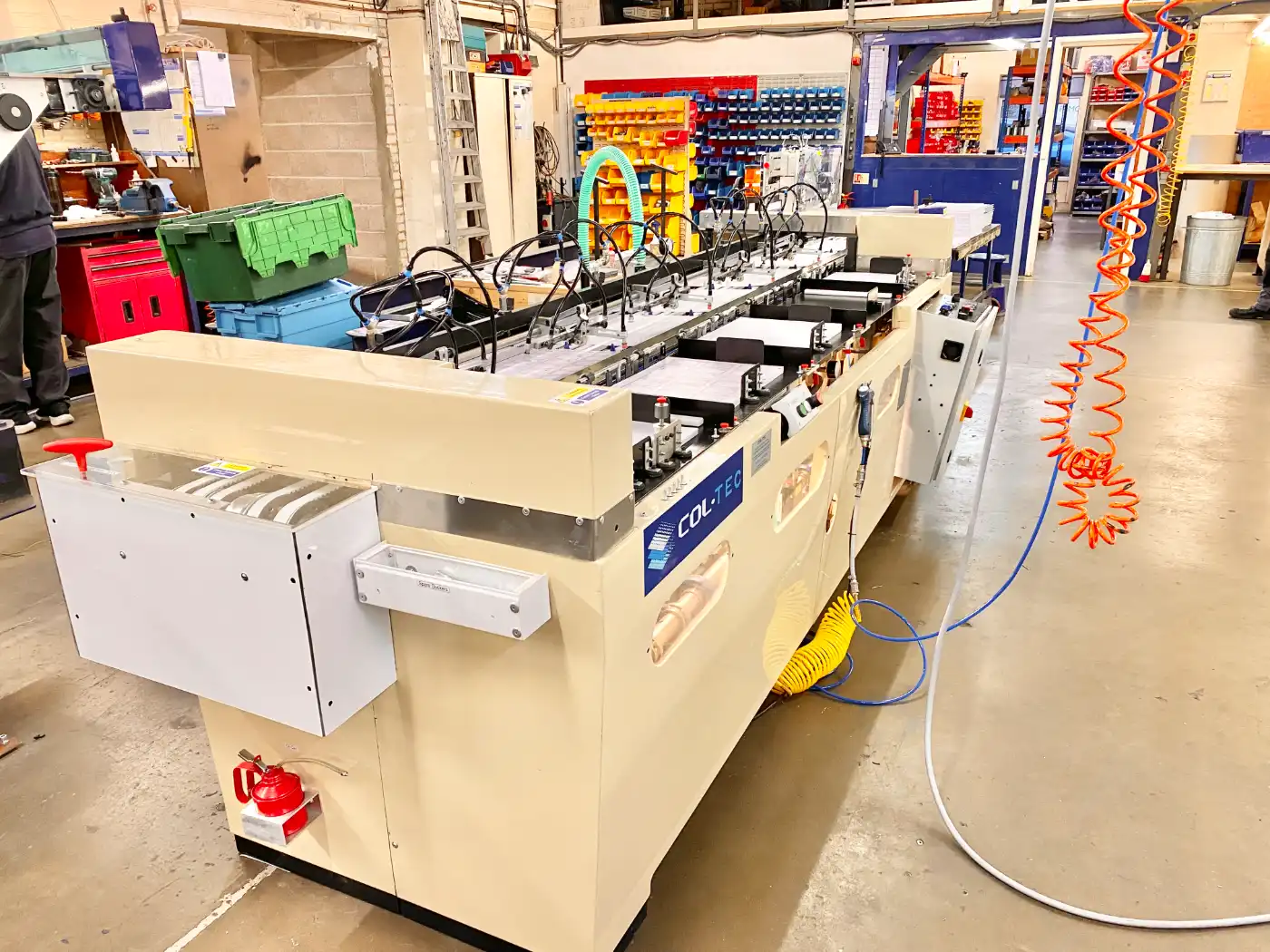
Production teams handling short runs, variable data, and mixed workloads require accurate sequencing and stable output. Therefore, understanding the difference between collate and group printing is essential. Collate printing arranges different sheets into complete, ordered sets. Meanwhile, group printing produces batches of identical sheets that are assembled later. It is this distinction that influences throughput, labour needs, and output consistency as job profiles change.
However, our smart collators use:
This helps them support both methods and maintain accuracy with different types of content. The features help reduce rework and improve predictability. It also helps align print output with downstream finishing.
Across UK manufacturing, digital transformation and automation have become central to productivity improvements. Recent Make UK research [1] shows that manufacturers investing in digital technologies see clear gains in operational efficiency. These benefits also apply to print production. Automated workflows reduce manual handling and help ensure more consistent output.
Collate printing gathers different sheets in a defined order to produce complete sets that follow a consistent sequence. This is essential in applications such as manuals, booklets, instruction packs, or multi-page inserts where accuracy matters across every cycle. In short-run variable-data environments, the sequence may change from one set to the next.
In which case, this increases the need for dependable automated control as:
These functions help operators keep quality, repeatability, and traceability. This is especially important in regulated or high-value work. Automated collation provides a reliable way to create precise sets. It lessens the need for manual effort and ensures consistent output.
Group printing refers to the production of batches of identical sheets before those sheets are assembled into sets. Instead of releasing a complete set every cycle, the press outputs one sheet type for an extended period. The focus is on maximising print engine efficiency for that sheet, rather than on producing finished sets immediately.
This method is useful when one component appears in many different sets, or when a job requires long runs of the same insert, cover, or card. For example, a plant may print a large batch of identical cards that will later be combined with other materials on a plastic card collator. These grouped stacks then feed into the collating line, where they are combined with other components to form final sets.
Smart collators integrate grouped output into the finishing process by drawing from dedicated stations that hold these pre-printed stacks. When used with press batching, these stations keep the press running smoothly. Meanwhile, the collator handles the complex task of assembling the final sets. Separating tasks helps us use print and finishing assets better in high-mix settings.
The main difference between collate and group printing is the workflow’s priority. Collate printing produces complete sets in the correct sequence for downstream finishing. Meanwhile, group printing focuses on efficient batching of identical sheets that are held for later assembly.
Both methods support different production goals within the same print environment:
By combining these approaches, smart collators enable operators to schedule work more flexibly while maintaining stable throughput. Stations can present grouped stacks alongside other sheet feeds that complete the set. This reduces manual handling and helps mixed workloads run without frequent mechanical changes.
Smart collators combine automated feeding, programmable set patterns, and verification options to manage both collated sets and grouped components. They provide controlled sheet handling across multiple stations, which is important when stock types vary or sets contain numerous materials.
For short-run, variable-data work, smart collators can store and recall set patterns for different jobs. Operators can move between jobs with minimal adjustment, reducing downtime between runs. When combined with press output grouped by component, this allows teams to run batches of standard components while still producing accurate sets at the collating stage.
Our Smart Collators are designed around horizontal collating technology that supports this type of workload. When additional engineering input is required, our bespoke engineering team can configure systems for specific applications, including unusual formats or complex multi-component sets.
Collate printing makes complete sets in a specific order. In contrast, group printing creates batches of the same sheets that are put together later. Understanding the difference between collate and group printing helps production teams:
Smart collators unify both approaches into a single system. Automated feeding, controlled sequencing, and programmable patterns help mixed workloads run accurately. This is true even when job profiles change often. With appropriate service support, these systems can provide reliable performance over long periods of use in demanding environments.
To find out how Col-Tec equipment, including lease rental options, can enhance your production line, contact the team.
Call +44 (0) 1425 627755 or arrange a consultation to get advice on choosing the correct configuration for your workflow.
[1] Make UK: https://www.makeuk.org/insights/reports/making-it-smarter-global-lessons-accelerating-automation-digital-adoption-uk
Recent Posts