
What Industrial Feeder Systems Suit Your Collating Line?
September 28, 2026
One detail sits at the heart of every collating line, and that’s how sheets are fed into the process, gathered into sets, and mov...


Picture a high-volume commercial print facility mid-run. Signatures are collating, the press is running at full speed, and downstream, a bottleneck is forming at the packaging station. Operators are transferring materials by hand, schedules are slipping, and the packaging equipment is working independently of everything upstream. This is a familiar scenario for finishing managers who have not yet aligned their packaging approach with their production demands.
The reason inline vs offline packaging matters goes beyond equipment selection. The point at which printed products move into packaging has a direct bearing on throughput, labour dependency and operational efficiency.
This article compares both systems in practice and helps print facilities identify the right approach for their production volume and automation strategy.
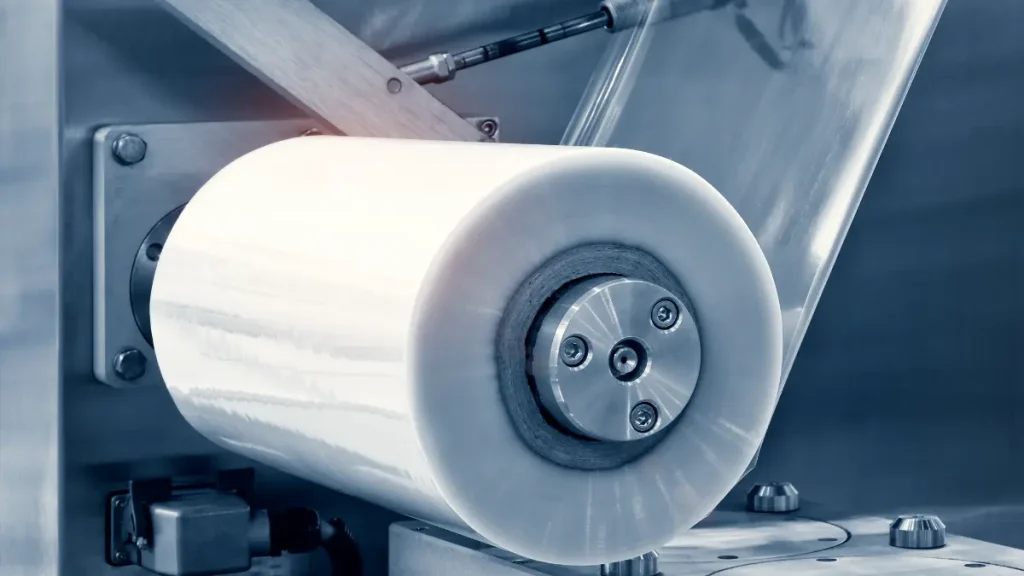
Inline film packaging systems operate as part of a continuous automated finishing line, with products moving directly from upstream processes into packaging without manual transfer. A typical workflow runs from printing press through folding, signature collating and film packaging to palletising.
Signature collators maintain consistent product orientation and prepare printed signatures for packaging downstream. When collating and packaging equipment are properly matched, the finishing line runs at a consistent speed with few interruptions between stages.
Investment in automation is accelerating across UK print facilities. According to the BPIF Printing Outlook Q4 2025, reported by Digital Printer Magazine, workflow and automation topped investment priorities for the year ahead, with over one-third of respondents reporting active use of robotics [1].
Offline packaging systems operate independently of the main finishing line. Finished printed materials are transferred to a separate packaging station, where operators batch and load products into the packaging machine. The upstream finishing and packaging processes are decoupled.
The relationship between printing speed and collation method is explored in more detail in our dedicated post, Does Your Collation Method Affect Overall Printing Speed?
Offline systems are well-suited to facilities that handle a variety of product formats or run shorter, more varied jobs where packaging specifications change frequently. Because the packaging station operates independently, format changes and film adjustments can be made without interrupting the upstream finishing line, which offers a degree of scheduling flexibility that inline systems do not.
The choice between inline and offline packaging affects production speed, labour demand and how easily equipment integrates with existing finishing lines. Each system carries distinct operational implications depending on production volume and plant configuration.
Inline systems maintain continuous packaging during production, reducing stoppages between finishing and packing. This supports higher throughput on large, consistent print runs and helps keep the finishing line balanced. Offline systems complete packaging after it is finished, which can create bottlenecks if packaging capacity does not match upstream output.
Inline packaging reduces manual input significantly. Automated transfer between processes removes the need for operators to move materials between stations. Offline systems require more hands-on handling between the finishing line and the packaging station, which carries a direct cost in high-volume environments.
The Automate UK Industry Insights Report 2024-25 found that investment costs are the leading barrier to automation adoption, cited by 60% of respondents, yet 83% believe automation is increasing across UK manufacturing. This is a tension that makes the labour-efficiency case for inline packaging increasingly relevant [2].
Inline packaging requires integration with upstream finishing equipment and may involve system configuration and workflow engineering. Offline packaging is simpler to install and can be retrofitted into existing production environments with lower integration complexity. For facilities taking their first steps towards automation, this distinction is often the deciding factor. For facilities weighing the financial case, take a look at our post, Why Industrial Print Equipment Upgrades Improve ROI.
Inline packaging delivers the greatest operational benefit in high-volume print production environments running long, consistent jobs. Inline systems are particularly effective when the packaging machine can be configured with infeed and outfeed conveyors, collection and grouping stations, and reject systems that connect directly to upstream collating equipment.
This level of integration removes manual transfer entirely and allows the finishing line to run as a single continuous process. For facilities producing high volumes of magazines, catalogues or direct mail packs on consistent specifications, the result is measurably faster output with fewer opportunities for handling errors.
Offline packaging remains practical for mixed or short production runs, facilities with space constraints on existing finishing lines, and operations that require flexible scheduling of packaging tasks. Smaller print plants transitioning gradually towards automation often begin with standalone packaging equipment before moving to fully integrated systems. Many facilities operate hybrid arrangements, using both approaches depending on the job specification.
Automation in print finishing is no longer driven solely by labour costs. Material efficiency, waste reduction and compatibility with sustainable film types are becoming operational priorities for commercial print facilities. Modern film packaging machines can process recyclable mono films, biodegradable films, and other environmentally friendly film types, meaning that investment in automated packaging now carries both a productivity and a sustainability case. Smaller operations are also moving in this direction, as the post on boutique printing automation in the UK illustrates.
As Print Monthly reports, print service providers that do not adopt automation risk falling behind competitors able to offer faster, cheaper, and higher-quality services, as manual processes are labour-intensive, prone to errors, and a barrier to growth as production volumes increase. Automated systems can handle larger volumes without a proportional increase in labour, helping facilities maintain output and remain competitive [3].
The operational gap between inline and offline packaging widens as production volumes grow. For high-volume finishing lines, the case for integrated packaging with configured infeed, outfeed and reject systems is strong. For mixed or shorter runs, a well-specified standalone system remains a practical solution. In both cases, the decision is most effective when made in collaboration with the equipment manufacturer.
Col-Tec designs and manufactures horizontal collating and film packaging systems built for commercial print environments. Whether a facility requires a fully integrated finishing line or a standalone solution, our team provides the engineering expertise and equipment to meet production requirements.
Call +44 (0) 1425 627755 or arrange a consultation to discuss the right packaging automation strategy for your production line.
[1] Digital Printer Magazine, BPIF Reports Strong Finish to 2025, Tentative Start to 2026: https://www.digitalprintermag.co.uk/news/129636/bpif-reports-strong-finish-to-2025-tentative-start-to-2026/
[2] Automate UK, UK Automation Industry Insights Report 2024–2025: Trends, Challenges, and Opportunities: https://www.automate-uk.com/industry-insights-2024-2025/
[3] Print Monthly, Rob Fletcher, Automation: Automate and Activate (2024): https://www.printmonthly.co.uk/features/automation-automate-and-activate/
Recent Posts

