
What Industrial Feeder Systems Suit Your Collating Line?
September 28, 2026
One detail sits at the heart of every collating line, and that’s how sheets are fed into the process, gathered into sets, and mov...


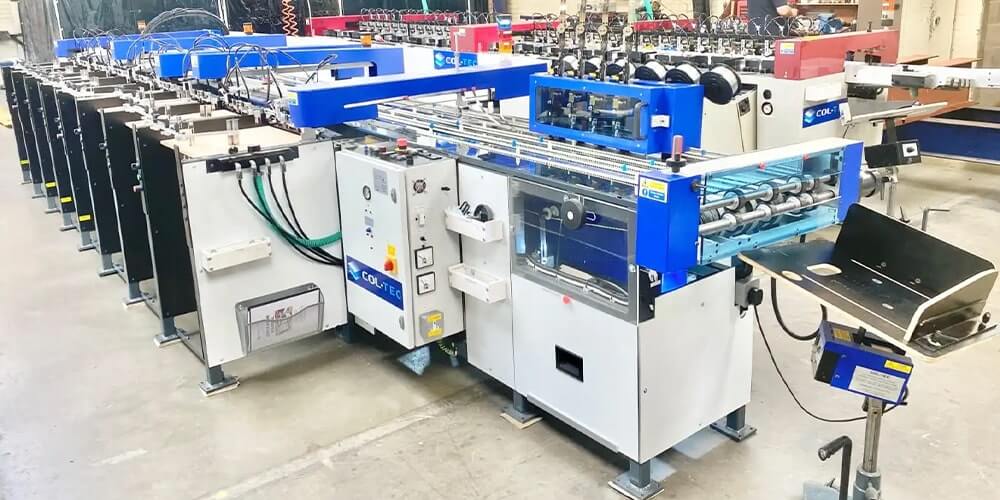
In book and magazine printing, the margin for error is narrow. A single missing section or misfed sheet can compromise an entire finished product, making collation one of the most consequential stages in any book production process.
Across long print runs, where thousands of sets move through the line in sequence, the demands placed on collation equipment are considerable. Consistent sheet feeding, reliable detection and precise section sequencing are not optional refinements. They are production fundamentals.
Understanding how these collating systems support those requirements begins with understanding what signatures are and why their format defines how collation must work.
A signature is a section of folded printed sheets that forms part of a finished book or booklet. Pages are printed in groups and folded together to create these sections, each containing a fixed number of pages determined by the fold configuration applied during the print run. The format used has a direct bearing on how sections must be handled and sequenced during book production.
The most common configurations are:
The signature format selected determines how sections must be sequenced, fed and collated through the production line.
Within a publishing workflow, the process of gathering individual folded sections in the correct sequence is where production integrity is either established or lost. Each station in a collator holds a separate signature, and as the set moves through the machine, each station adds its section to the growing stack in the correct order. The result, when the equipment operates as it should, is a complete and properly sequenced set ready for the finishing stage.
The importance of this process is difficult to overstate. An error in sequencing, or a section placed in the wrong position, produces a defective finished product that cannot be corrected after binding. Collation therefore functions as the quality checkpoint that precedes all downstream processes. Maintaining that performance across a full production run requires sheet handling equipment capable of sustaining accuracy from station to station, regardless of substrate variation or run length.
The mechanical demands of sheet handling increase significantly with run length. In a single-shift environment, a collator may be required to feed and sequence tens of thousands of sheets without interruption. For equipment to perform consistently across those volumes, the feeding mechanism must be capable of managing variation in substrate weight, caliper and condition, while maintaining precise registration throughout the run.
In the book production process and in magazine printing, substrates are rarely uniform across an entire order. Paper weight may vary between sections, and sheets that have been stored or transported may present with minor dimensional changes. Equipment that cannot accommodate this variation will experience feed errors, which accumulate in both frequency and severity as run length increases.
Reliable sheet handling therefore demands not only a consistent feed rate, but a system capable of adapting to substrate variation without generating waste or requiring manual intervention.
When a collator fails to pick a section from a station, the result is a set with a missing signature. In commercial production, these events are known as miss-sheets, and their consequences extend well beyond the individual set. Without a correction mechanism in place, a missed section does not simply produce one defective finished product. Depending on the stage at which the error is identified, it may trigger a downstream cascade, disrupting the binding or trimming sequence and requiring manual re-sorting of affected sets.
Miss-sheet correction systems address this by monitoring each station during the collation run. When an error is detected, the affected set is rejected automatically, removing defective output from the line before it reaches the finishing stage. For book production operations managing long runs or tight delivery schedules, automated detection and rejection is not a supplementary feature. It is the mechanism by which finished output quality is maintained from the first completed set to the last.
The demands placed on a collation system by publishers and commercial print operations can be grouped into four core requirements:
Meeting all these requirements consistently depends on the feeding technology at the core of the collation system.
Suction-feed technology has long been the preferred feeding mechanism for collating operations that require consistent performance across varied substrates. Unlike friction-based feeding systems, which rely on mechanical contact with the sheet surface, a suction-feed collator uses negative air pressure to lift and separate each sheet from the pile. This approach allows the system to handle a wide range of paper weights and finishes without the surface degradation or static accumulation that friction-based feeding can produce.
For the demands of book and magazine publishing, suction-feed collators offer reliable performance across the substrate ranges most commonly encountered in those environments. Col-Tec has been designing and manufacturing suction-feed collating systems for 50 years, with a particular focus on the requirements of publishing, periodical production and bookbinding applications. That depth of application knowledge informs the engineering specification of every machine the company produces.
Col-Tec designs and manufactures collating systems for publishers, commercial printers and print finishing operations worldwide. With 50 years of engineering expertise in the design and manufacture of collating equipment, the company has detailed knowledge of the demands placed on collation systems across a wide range of production environments.
To discuss your requirements, contact the Col-Tec team directly on +44 (0) 1425 627755 or complete the enquiry form on our website. A member of the team will be in touch to discuss the right solution for your operation.
Recent Posts

